
Introduction to CDC (Change Data Capture) with Debezium: The Ultimate Solution for Real-Time Data Integration
Published · Feb 3, 2026
This English translation was generated with AI and may contain errors. Refer to the Japanese original for the authoritative wording.
Read the Japanese original (Opens in a new tab)In modern system development, "how to convey database changes to other systems with low latency" is a crucial challenge. Traditional data synchronization using "nightly batches" can no longer keep up with the speed of business.
This is where CDC (Change Data Capture) is attracting attention. In this article, we explain the mechanisms and benefits of CDC, focusing on Debezium (Debezium), which is the de facto standard for CDC.
1. What is CDC (Change Data Capture)?
CDC is a technology that instantly detects row-level changes (INSERT / UPDATE / DELETE) occurring in a database (source DB) and propagates them to another system (target).
2. Why Debezium is Chosen
Debezium is an open-source platform for implementing CDC. It mainly features the following characteristics:
Log-Based Capture
Instead of directly SELECT DB tables, Debezium directly reads the internal "transaction logs (such as WAL, binlog)" of the DB.
- Low Load: Does not interfere with application query execution.
- Deletion Detection: Can accurately detect "physical deletions," which are difficult with query-based approaches.
- 100% Capture: By tracking logs, it never misses changes that occurred for just an instant.
Rich Database Support
It covers major databases such as PostgreSQL, MySQL, Oracle, SQL Server, and MongoDB.
3. Comparison with Conventional Batch Processing
Let's compare CDC with traditional batch processing (ETL) to see how superior it is.
| Comparison Item | Conventional Batch (ETL) | Debezium (CDC) |
|---|---|---|
| Propagation Timing | Every few hours to 1 day (Slow) | Near real-time (Extremely fast) |
| Source DB Load | Temporarily high load due to heavy queries | Extremely low load due to log reading |
| Deletion Detection | Difficult (Requires full comparison) | Easy (Detected via DELETE logs) |
| Data Freshness | Low (Yesterday's data) | High (Current data) |
4. Debezium Architecture
Debezium typically operates in combination with Apache Kafka and Kafka Connect.
- Source DB: Such as MySQL or PostgreSQL.
- Debezium Connector: Monitors transaction logs and converts changes into events (JSON or Avro).
- Apache Kafka: Holds change events as messages (topics).
- Target: Such as Elasticsearch (for search), Snowflake (for analytics), Redis (for caching).
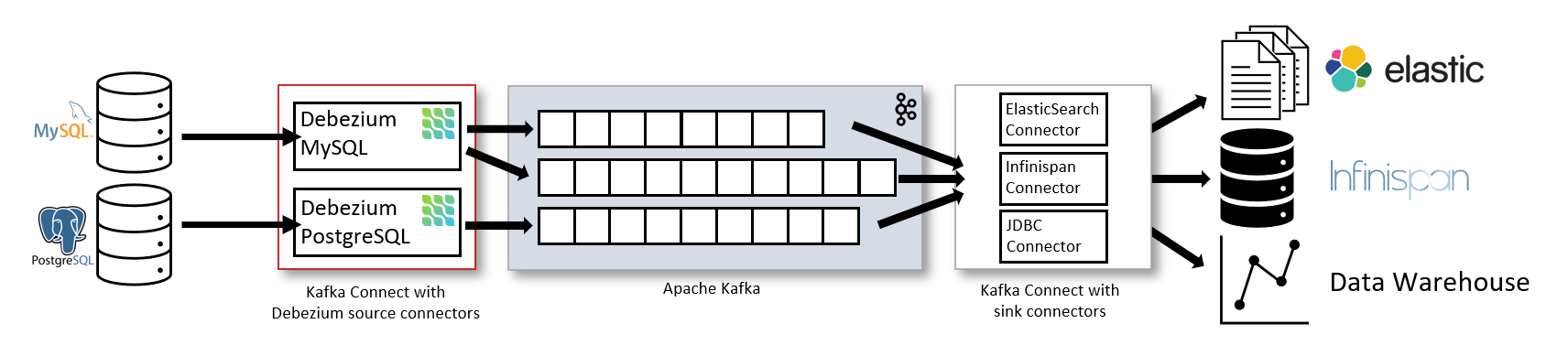 Source: From official Debezium documentation
5. Main Use Cases
① CQRS (Command Query Responsibility Segregation)
Detects writes to the main DB (for updates) and updates search-optimized databases (such as Elasticsearch) in real-time.
② Data Synchronization Between Microservices
When Service A's DB is updated, automatically reflecting that event in Service B's DB maintains data consistency while preserving loose coupling between services.
③ Real-Time Analytics
Synchronizes with a DWH (Snowflake or BigQuery) the moment data is updated, enabling up-to-date dashboard displays and fraud detection.
6. Important Notes on Implementation (Tips)
Conclusion
CDC using Debezium evolves data infrastructure from "static batch processing" to a "dynamic event stream."
- You want real-time capabilities
- You want to reduce the load on the DB
- You want to reliably synchronize deleted data as well
If any of these apply to you, please consider implementing Debezium.
Reference Links
Bonus: Regarding New Features in Debezium 3.2 (as of 2026)
In the latest Debezium 3.2 series, support for serverless environments and enhanced observability via OpenTelemetry have progressed, making operation in large-scale distributed systems much easier.